
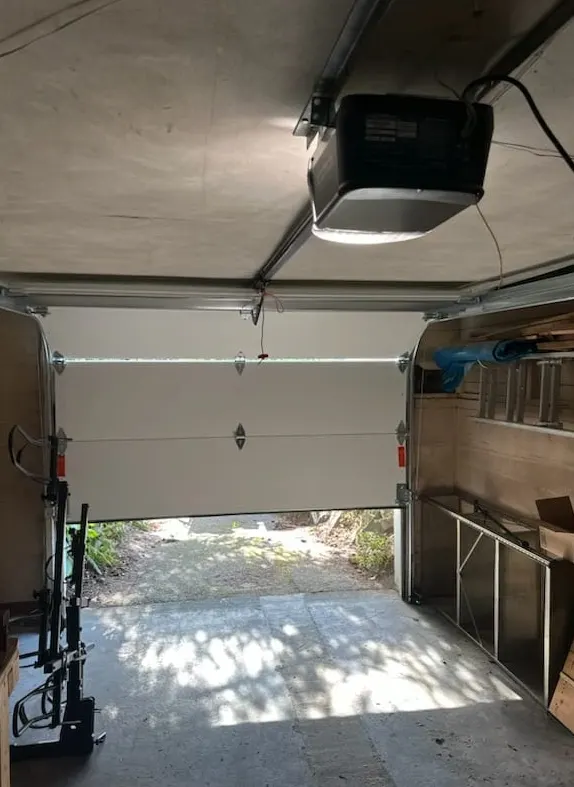
A Familiar Call This Time of Year
A technician pulls into a driveway in Germantown and the homeowner is standing in a half-open garage, car still inside, door frozen about waist-high. The story is almost always the same: the opener quit working, someone remembered the red cord, pulled it to free the door by hand, and now the door won't budge up or down. Sometimes it's worse — the door has dropped the rest of the way on its own weight, with a bent track or a cracked panel to show for it. This happens more in late fall and winter here, when cold-stiffened rollers, ice on the track, or a dead opener battery all hit at once and people reach for the emergency release without knowing what it actually disconnects.
What the Cord Is Actually For
The emergency release cord disconnects the door from the opener's trolley, so you can raise or lower the door by hand. It exists for one situation: the opener has failed or lost power and you need to get the car out. It does not disconnect the springs. The springs are still fully loaded with tension, and once the door is free of the opener, that tension — not the opener, not you — is what's actually holding the door up or controlling how it moves.
When Pulling It Helps
- Power outage during a storm and you need to get a vehicle out before the roads get worse
- Opener motor has clearly failed (burning smell, stuck gear, no response at all) and the door is sitting in the down position
- You're manually testing whether the door moves smoothly on the track, with the door already closed and supported
When It Makes Things Worse
- Pulling it while the door is up or halfway open. Without the opener holding it, a door with a broken or weakened spring can slam down fast and hard, with no warning. Hands, fingers, and pets near the opening are at real risk.
- Pulling it when you already suspect a spring problem. If the door has been heavy, slow, or crooked lately, the spring may already be carrying less tension than it should. Releasing the opener removes the one thing keeping the door under control.
- Pulling it in deep cold without checking the track first. Ice buildup, road salt residue, or a track that's shifted slightly out of alignment can cause the door to bind, jump the track, or come off the rollers entirely once it's released.
- Yanking the cord hard instead of pulling straight down. This can damage the release mechanism itself, which then needs its own repair on top of whatever problem started the call.
What Actually Goes Wrong, and How Badly
The common outcomes a technician sees after a mishandled release: a door that drops onto a car bumper or a parked bike, a track bent from a door that jumped its rollers, a release mechanism that's snapped and needs replacing, or a homeowner standing under a door that's stuck in the worst possible position — half up, unsupported, blocking the opening in freezing weather. None of these are emergencies that require calling 911, but all of them turn a simple fix into a bigger repair bill and a longer wait to get the garage usable again.
The Few Steps That Prevent It
- Only pull the cord when the door is fully closed, if at all possible.
- If the door is open and the opener has failed, support the door manually (or get help) before releasing it, and lower it slowly by hand.
- Know the signs of a weak spring beforehand — a door that feels heavier than usual, closes unevenly, or makes a loud bang are all warnings that the spring, not just the opener, needs attention.
- In winter, clear visible ice or frost from the track before operating the door manually, since a frozen track changes how the door moves once it's free.
- After reconnecting the opener, test the door through a full cycle to confirm the trolley has re-engaged correctly.
When to Call Germantown Garage Door Experts
If your opener has failed, your door is stuck halfway, or you've already pulled the release and the door won't move safely in either direction, that's the point to stop and call rather than keep working on it. We handle garage door opener repair and installation for exactly this kind of failure, and we check spring tension and track alignment as part of any service call, since those two things determine whether a door is safe to operate by hand in the first place. We serve Germantown and the surrounding Washington County communities, and we show up ready to diagnose the actual cause, not just free up a stuck door temporarily.
If your garage door isn't behaving the way it should heading into winter, call Germantown Garage Door Experts and get it looked at before the next cold snap turns a small issue into a stuck one.