
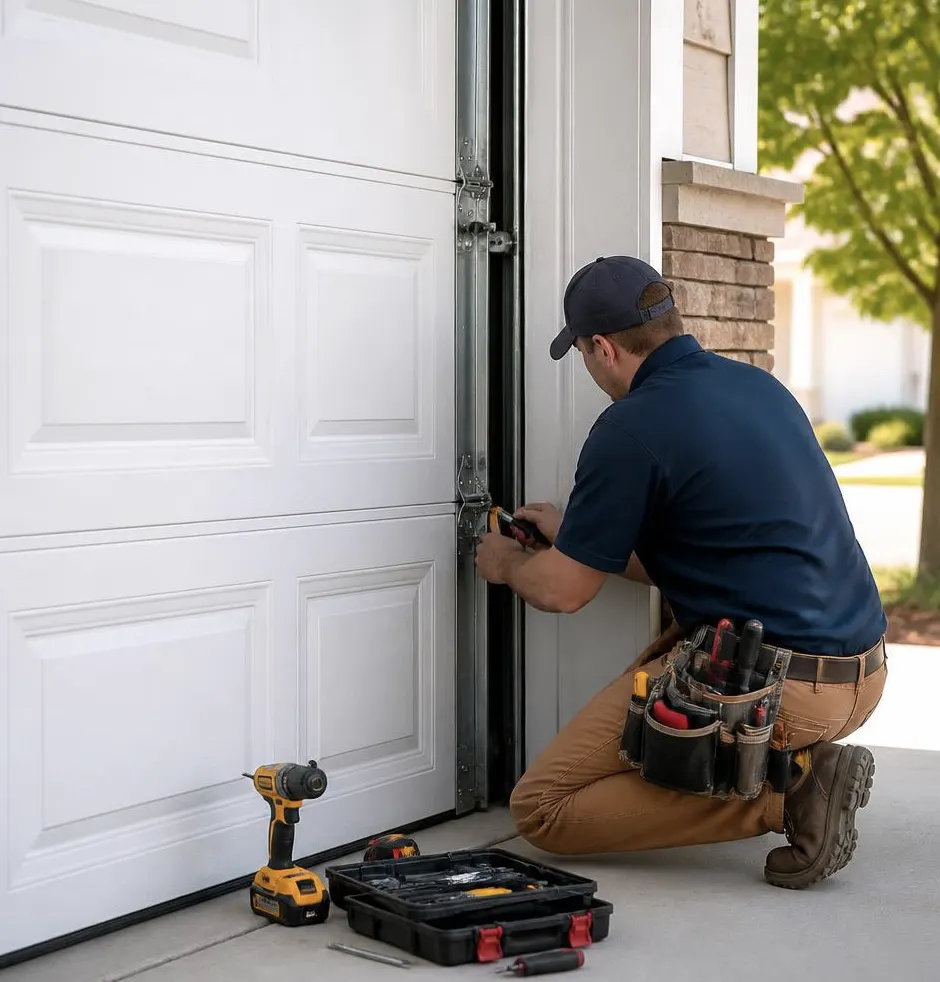
The Rule, and Why People Ignore It
If a repair involves a spring, a cable, or anything coiled under tension, it is not a DIY job. That's the rule. The exceptions people talk themselves into — "it's just a small spring," "it already looks loose," "I watched three videos" — are the exact reasons emergency rooms see the same injury pattern every year: facial trauma, broken fingers, crushed hands, and lacerations from a torsion spring that let go mid-adjustment.
The videos make it look simple because the person filming has done it a hundred times and still keeps both hands clear of the bar. The injuries happen to the person doing it for the first time.
What Actually Goes Wrong
A standard torsion spring sits above the door, wound tight enough to lift 100-400+ pounds of door panel, track hardware, and insulation. That tension doesn't ease off gradually — it's either fully wound or it isn't. When someone loosens the set screws without a properly seated winding bar, or uses a screwdriver instead of the correct tool, the spring can unwind violently in a fraction of a second.
- The winding bar becomes a projectile. If it slips out of the cone under load, it doesn't fall — it's thrown, often toward the face and chest.
- The spring itself can fracture. A worn or rusted spring under tension can snap and send metal fragments across the garage.
- Cables add a second hazard. Extension spring systems use separate safety cables; without them routed correctly, a failed spring can send a stretched cable whipping back.
- Fingers get caught between coils, in the winding cone, or in the track during reassembly — a common source of crush injuries and amputated fingertips.
None of this requires a defective spring. A correctly functioning spring, handled with the wrong tool or the wrong technique, is enough.
How Badly Things Go Wrong
This isn't a sprain-your-wrist kind of mistake. The injury reports tied to DIY spring work consistently include broken facial bones, detached retinas, deep lacerations requiring stitches, crushed hands, and in rare but documented cases, fatalities. The force involved is comparable to a loaded crossbow — it just doesn't look like one sitting quietly above a garage door.
Why Germantown Winters Raise the Stakes
Cold makes a bad situation worse. Steel springs lose some flexibility in deep cold, and a spring that's already fatigued or slightly rusted from road salt and winter humidity is more likely to snap rather than unwind predictably. A door that's picked up extra weight from ice or packed snow puts more load on a spring that's already working at its limit. If a spring is going to fail, it often picks the coldest week of the year to do it — right when a homeowner is most tempted to deal with it fast, alone, in a cold garage, instead of waiting for help.
Spring thaw brings its own version of the problem: moisture gets into the coils, rust sets in over weeks, and a spring that looked fine in January can be dangerously weakened by April.
What a Safe Spring Replacement Actually Requires
This isn't a matter of courage or mechanical skill — it's a matter of specific equipment most garages don't have:
- Properly sized winding bars (not screwdrivers, not rebar) matched to the winding cone
- A locking mechanism or clamp to hold the door in place while the spring is unloaded
- Correct spring sizing — wire gauge, coil diameter, and length all have to match the door's weight and track geometry, not just the spring that happens to be for sale locally
- Knowledge of torque — how many quarter-turns a specific door needs, which varies by door weight and spring type
- Safety cables installed correctly on extension spring systems
Professional spring replacement typically runs in the range of $150–$350 depending on spring type and door size — a cost that's hard to justify skipping when the alternative is an ER visit and still needing to hire someone to finish the job correctly.
Warning Signs Your Spring Is Close to Failing
- A loud bang from the garage (often mistaken for something falling) — frequently the sound of a spring snapping
- The door feels noticeably heavier when lifted manually
- Visible gap in the coils of a torsion spring
- The door opens unevenly or jerks partway through its travel
- The opener strains, reverses, or stalls on doors that used to move smoothly
Any of these is a signal to stop using the automatic opener and call for service — a door with a failing spring can drop suddenly, and the opener isn't designed to compensate for a dead spring.
When to Call Germantown Garage Door Experts
If you've noticed any of the warning signs above, or you've already had a spring snap, that's exactly the call to make rather than the project to start. Our technicians bring the correct winding bars, door clamps, and properly matched springs for your door's weight and age, and we handle spring replacement as a routine, controlled job — because it is, with the right equipment and training. We also offer garage door maintenance visits that catch rust, fatigue, and coil gaps before they turn into a sudden failure on a sub-zero morning.
If your door sounds off, feels heavy, or you've heard a bang from the garage, call Germantown Garage Door Experts. We serve Germantown and nearby communities including Menomonee Falls, Mequon, Richfield, Hubertus, Jackson, Cedarburg, and West Bend, and we'll get your spring replaced safely and your door back to normal.